Good Old-Fashioned AI: The Secret Ingredient in a Modern Voice Assistant

JarbasAl
OVOS Contributor
Good Old-Fashioned AI: The Secret Ingredient in a Modern Voice Assistant
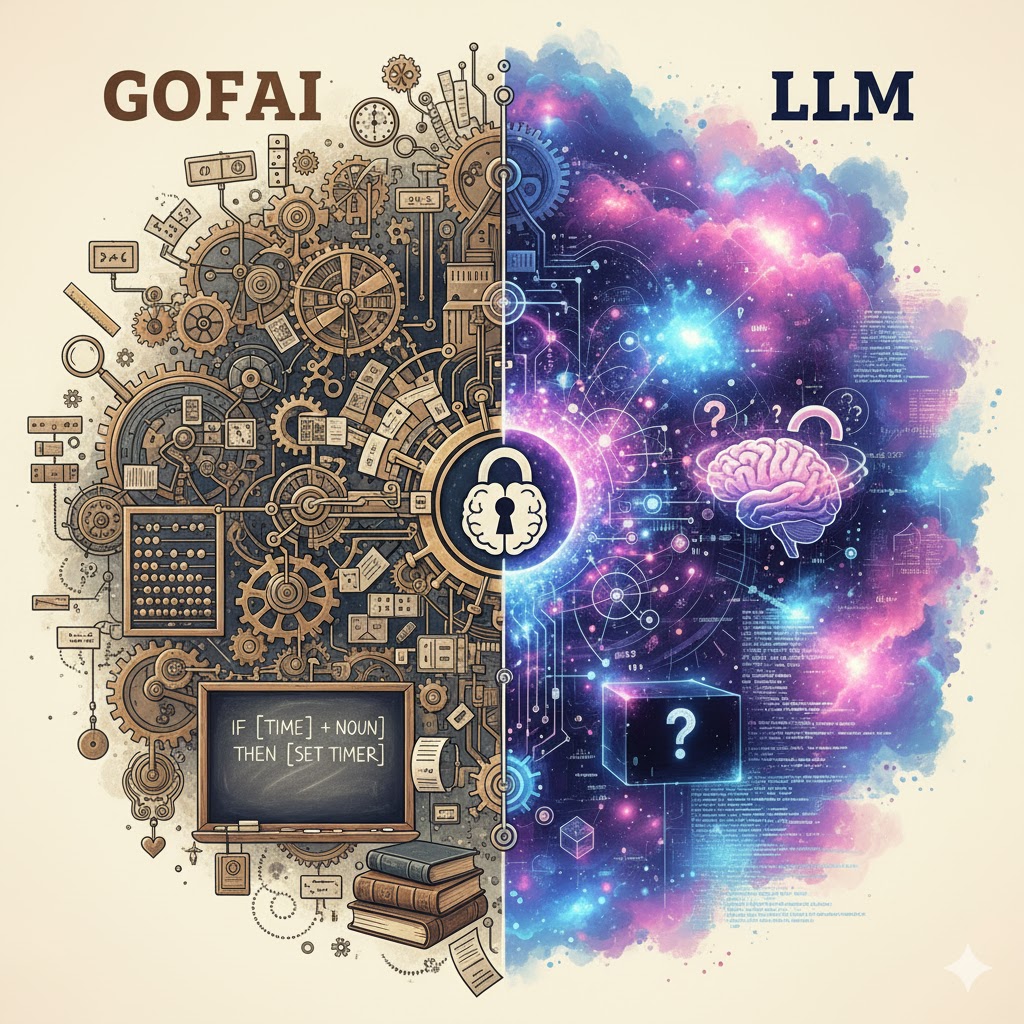
In an era dominated by probabilistic giants like Large Language Models (LLMs), it might seem counterintuitive to advocate for a more traditional approach to Artificial Intelligence. Yet, OpenVoiceOS (OVOS) deliberately grounds its core architecture in Symbolic AI, often referred to as Good Old-Fashioned AI (GOFAI).
This isn’t nostalgia, it’s engineering discipline. GOFAI provides predictable precision where voice assistants need it most: deterministic, fast, and transparent decision-making. Rather than chasing generalized intelligence, OVOS builds on logic, structure, and explainability, the ingredients of reliability.
The GOFAI Philosophy: Precision Over Probability
Symbolic AI, the dominant paradigm from the 1950s through the 1990s, is built on explicit rules and formal logic. Instead of learning from massive datasets, it reasons with structured knowledge.
While LLMs are masters of generalization, they operate in a world of probabilities, a risky trait for voice assistants. For a task like “set a timer for three hours,” almost correct isn’t good enough. OVOS rejects this uncertainty for the foundational layers of its system, relying on GOFAI to handle the tasks that demand perfect precision: parsing numbers, times, colors, and other concrete entities.
This represents a deliberate trade-off: OVOS accepts the cost of manual rule design in exchange for guaranteed correctness, full transparency, and instant local execution, traits essential for embedded, privacy-respecting systems.
Key Advantages of the Rule-Based Approach
-
🪞 Interpretability and Debugging – Every rule is explicit. When something goes wrong, a developer can pinpoint exactly where and why. This transparency makes open-source collaboration possible, any contributor can trace and fix an issue without black-box guesswork.
-
⚡ Performance and Efficiency – Static rule sets mean ultra-low latency and negligible compute load. Unlike LLMs that require large memory and GPU cycles, GOFAI parsers run instantly on modest hardware, ideal for offline or embedded devices.
-
🎯 Guaranteed Precision – GOFAI is often criticized as “brittle” beyond its domain. But for tightly scoped operations, like setting timers, adjusting volume, or parsing commands, this rigidity is a feature, not a flaw. It ensures the system behaves predictably every single time.
The OVOS Parser Toolkit: GOFAI in Action
OVOS integrates a family of rule-based parsers that each specialize in a precise data type. They’re distributed as standalone Python packages—available to any developer needing high-precision, multilingual parsing.
Within OVOS, these parsers aren’t used for broad Named Entity Recognition (NER). Instead, they’re invoked after an intent is identified. Once a skill knows what kind of data to expect, these parsers ensure it’s extracted and converted flawlessly.
Numerical Mastery — ovos-number-parser
Parsing numbers is deceptively complex. Humans use digits, words (“twenty”), ordinals (“first”), and fractions (“half”), often mixing them fluidly.
ovos-number-parser handles these with meticulous, multilingual rule sets to produce exact numeric values.
This matters more than it seems: even “one billion” means different things across languages. English uses the short scale (1,000,000,000), while French or German follow the long scale (1,000,000,000,000). Rule-based, language-aware parsing guarantees consistent results across locales, critical for mathematical accuracy in global deployments.
Temporal Precision — ovos-date-parser
Time is contextual: “tomorrow at noon” means nothing without a reference point.
ovos-date-parser converts these human phrases into exact datetime objects, handling relative expressions like “three days ago” or “next Friday” with surgical precision.
Identifying the Spectrum — ovos-color-parser
For tasks like setting smart light colors or adjusting UI themes, ovos-color-parser maps natural language directly to color values.
It recognizes everything from “dark goldenrod” to RGB notation using explicit syntax rules and lookup tables.
This is a textbook GOFAI application: a deterministic, low-latency parser that achieves perfect accuracy without machine learning overhead.
The Language Linchpin — ovos-lang-parser
The ovos-lang-parser extracts language references from user commands, for instance, turning
“How do I say ‘hello’ in French?” → "French" → "fr" (BCP-47 code).
The Symphony: GOFAI in Harmony
The power of OVOS’s design becomes clear when these parsers work together.
Consider what needs to happen in the command:
“In three hours, the light should be set to cyan at fifty percent brightness.”
- The intent engine activates the relevant skills (timer and light control).
- The timer skill uses
ovos-date-parserto resolve “in three hours” to a futuredatetime. - The light control skill uses
ovos-color-parserto map “cyan” to an exact color code. - The same skill calls
ovos-number-parserto convert “fifty percent” to the value0.5.
All of this happens locally, instantly, and deterministically, no cloud, no lag, no guesswork.
The Future is Collaborative and Deterministic
Building on GOFAI is not a step backward, it’s a step toward trustworthy AI. OVOS’s rule-based foundation ensures reproducibility, transparency, and full user control.
While refining these rules demands human expertise, the classic knowledge bottleneck, OVOS turns that into a feature, not a flaw. By inviting developers to become knowledge engineers, it transforms AI development into a collective, interpretable, and sustainable process.
In a world chasing statistical magic, OVOS stands as proof that determinism is not limitation, it’s reliability. A system you can understand is a system you can trust.
Help Us Build Voice for Everyone
OpenVoiceOS is more than software, it’s a mission. If you believe voice assistants should be open, inclusive, and user-controlled, here’s how you can help:
- 💸 Donate: Help us fund development, infrastructure, and legal protection.
- 📣 Contribute Open Data: Share voice samples and transcriptions under open licenses.
- 🌍 Translate: Help make OVOS accessible in every language.
We're not building this for profit. We're building it for people. With your support, we can keep voice tech transparent, private, and community-owned.