OVOS & HiveMind in the Manufacturing Industry

JarbasAl
OVOS Contributor

OVOS & HiveMind in the Manufacturing Industry
This blog was originally posted in the TigreGotico website
As the lead developer of OpenVoiceOS, maintained by a non-profit, and the creator of HiveMind, I’ve always believed in open, privacy-respecting voice technology. What I did not anticipate was how quickly these tools would end up in industrial research, especially without any direct involvement from me.
The COALA and WASABI EU projects have built an entire industrial voice-assistant framework around OVOS + HiveMind, integrating them with their own tools, UI, and conversation engines.
I am not involved with these deployments, but the fact that the stack is being adopted organically is a strong validation of its design.
WASABI Open Call
The 2nd WASABI Open Call to provide financial support to at least 10 experiments led by SMEs recently closed. This open call is designed to support AI-based digital assistance experiments involving SMEs from manufacturing.
All WASABI Open Call experiments are required to:
- run the WASABI/COALA OVOS Docker stack
- connect via HiveMind
- develop a custom OVOS Skill containing their industrial logic
The usage of OVOS/Hivemind is explained in these 2 documents from the Wasabi project:
Examples of Industrial Applications
1. Worker Guidance & Assembly Support
Experiments like TICONAI and SKITE are using OVOS skills to guide workers during complex tasks such as assembling components, validating procedures, or providing step-by-step instructions hands-free.
2. Quality Control and Error Reduction
Projects like WALLABI and HUMANENERDIA focus on providing workers with real-time instructions and checklists to prevent mistakes. Voice assistants help operators verify settings, remember safety checks, or cross-check parameters.
3. Predictive Maintenance Assistance
Experiments such as GENIUS-PM use the assistant to give maintenance techs quick access to machine health data, fault explanations, and repair steps—especially when their hands are occupied.
4. Logistics, Material Handling & Warehouse Support
VELO and AIVEA use voice to help workers locate items, confirm inventory, or check delivery tasks while moving around a shop floor.
5. Onboarding and Training
ONBOARD and AI-MODE test how new employees can be guided through tasks using voice guidance, reducing the burden on supervisors.
6. Sustainability, Waste Tracking & Resource Efficiency
VAFER integrates voice interfaces with systems that monitor recycling, material reuse, and resource flows—hands-free reporting in factory environments.
All of these rely on OVOS and on HiveMind for routing communication between devices, Android UI, and backend systems.
What COALA/WASABI Built on Top of OVOS
Although the projects produced no open-source industrial skills, they did create several components around OVOS + HiveMind:
1. A RASA-based Domain Assistant (DA)
Earlier COALA research developed a RASA NLP pipeline trained on manufacturing conversations (about quality checks, troubleshooting, machine operation). In WASABI, this RASA engine is plugged into OVOS as a skill, handling domain-specific dialog.
2. The COALA Android App
An Android front-end for workers, connecting to OVOS through HiveMind.
Early version released here: https://github.com/BIBA-GmbH/Mycroft-Android
Features include:
- login via Keycloak
- text or voice chat
- UI for instructions, warnings, and notes
- HiveMind-based messaging
3. A Full Docker-Based Industrial Stack
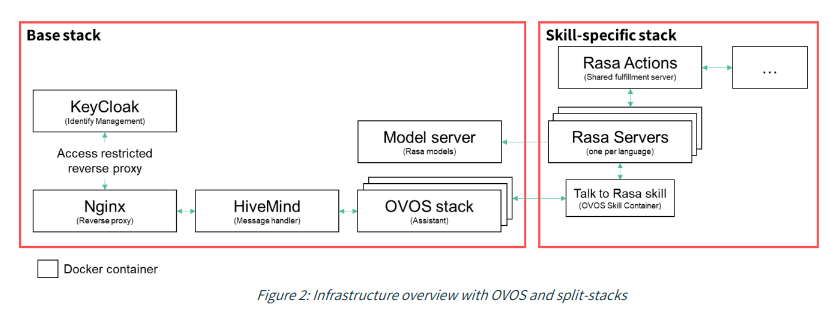
Both projects ship a preconfigured Docker environment bundling:
- OVOS
- HiveMind
- Keycloak (user management)
- RASA NLP engine
- COALA connector services
This forms the standard industrial voice-assistant stack that all WASABI experiments must deploy.
4. An Industrial Speech Dataset
COALA published a speech dataset recorded in factories and workshops: https://zenodo.org/record/8268928
Why Industry Chooses OVOS + HiveMind
The appeal is straightforward:
- Full transparency (crucial for regulated sectors)
- Local/edge deployment (no cloud dependency)
- Easy to integrate into existing equipment
- Modular enough for custom proprietary skills
- Distributed voice networks (HiveMind satellites across a factory)
In short: the combination is flexible, vendor-neutral, and respects industrial data constraints.
Closing Thoughts
I didn’t set out to build an industrial standard. I set out to build something open, reliable, and user-controlled.
Seeing OVOS and HiveMind adopted by COALA/WASABI, without my involvement or promotion, is a quiet but powerful sign that open-source voice technology is maturing.
A transparent, modular voice stack is no longer just a community dream.
It’s becoming part of the industrial toolset used to guide workers, reduce errors, improve maintenance, and ensure safer operations.
This is only the beginning.
Help Us Build Voice for Everyone
OpenVoiceOS is more than software, it’s a mission. If you believe voice assistants should be open, inclusive, and user-controlled, here’s how you can help:
- 💸 Donate: Help us fund development, infrastructure, and legal protection.
- 📣 Contribute Open Data: Share voice samples and transcriptions under open licenses.
- 🌍 Translate: Help make OVOS accessible in every language.
We're not building this for profit. We're building it for people. With your support, we can keep voice tech transparent, private, and community-owned.