Voice: 5× Faster Than Typing and ready for the AI era

Peter Steenbergen
OVOS Contributor
Voice Is (Again) the New Interface
5× Faster than typing and far smarter than keystrokes
For decades, we’ve accepted keyboards, touchscreens, and endless menus as the default way to interact with computers. We type emails. We click buttons. We fill in forms.
And yet, none of this is natural.
Humans didn’t evolve to communicate through keyboards. We evolved to speak.
This belief has always been at the core of OpenVoiceOS: voice-first interaction should be open, user-controlled, and respectful of privacy.
Now, as artificial intelligence becomes more capable than ever, the mismatch is obvious: incredibly powerful systems are still locked behind slow, outdated interfaces.
Voice is not just returning. It’s becoming essential.
Speed matters and voice wins, hands down
The numbers are hard to ignore:
- Average speaking speed: ~130–160 words per minute
- Average typing speed: ~40–60 words per minute (experienced typists)
- Most people: closer to 20–30 words per minute
That means speaking is up to five times faster than typing.
In real-world terms, this translates to:
- Less time entering information
- Fewer interruptions to your workflow
- Faster access to systems, tools, and knowledge
Stanford University study showed that voice input on smartphones was around three times faster than typing and often more accurate, thanks to modern deep-learning-based speech recognition.
Voice removes the input bottleneck
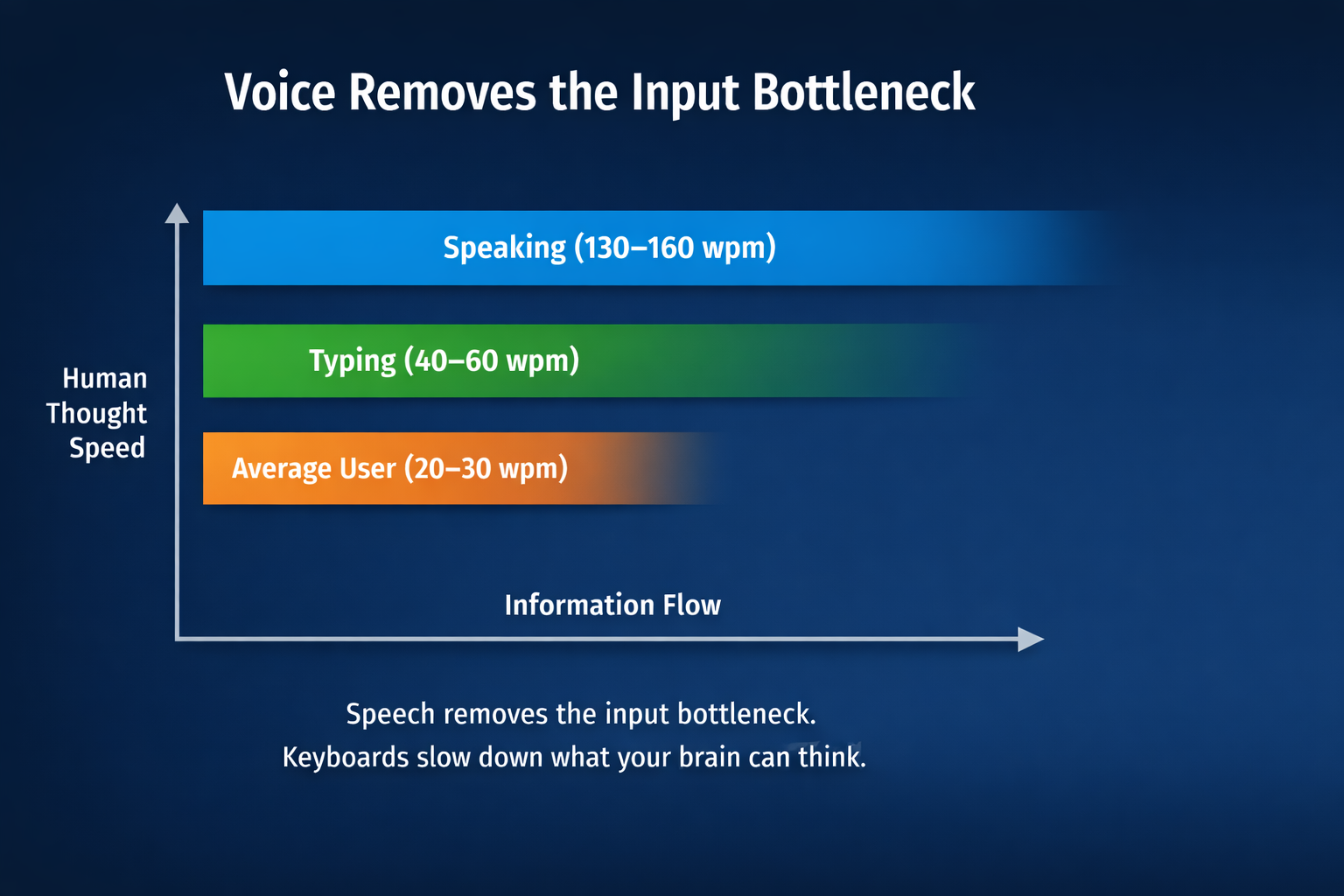
Speech removes the input bottleneck.
Humans think faster than they type. Voice aligns input speed with natural cognition, while keyboards artificially slow interaction with modern AI systems.
Speed isn’t a luxury. At scale, it’s a competitive advantage.
AI Has leaped forward however interfaces have not
Over the last few years, AI has taken a massive leap forward.
Large Language Models, autonomous agents, copilots, and smart systems can reason, summarize, plan, and act. Yet most of them are still accessed through:
- Keyboards
- Text boxes
- Click-heavy user interfaces
This creates a clear bottleneck.
Powerful intelligence, trapped behind slow input.
At OpenVoiceOS, we see voice as the missing interface layer for modern AI — one that connects humans to intelligence at the speed of thought.
Voice allows you to:
- Talk directly to your smart environment
- Control AI agents and language models naturally
- Interact without breaking focus or switching context
And crucially, this does not require sending your data to the cloud.
OpenVoiceOS is designed to be able to run locally, offline, and is fully open source.
Voice isn’t a novelty feature. It’s the most efficient way to access intelligence.
Voice-First is more natural and more inclusive
Voice changes how we interact across environments:
- In homes and offices
- On factory floors and in warehouses
- In cars, on bikes, and on the move
- In healthcare, logistics, and field work
The advantages are immediate and practical:
- Hands-free operation: safer and more efficient
- Faster documentation: speak instead of type
- Accessibility by design: empowers people with disabilities, RSI, or limited mobility
Unlike traditional UI shortcuts, voice doesn’t require training. Speaking is universal.
This focus on accessibility and inclusivity is a recurring theme within the OpenVoiceOS community, where voice is not treated as a convenience feature, but as a fundamental interface for everyone.
With OpenVoiceOS, voice-first also means:
- No forced cloud dependency
- No opaque data harvesting
- Full transparency and control
Fast. Local. Private.
Voice makes AI smarter, too
Voice isn’t just faster, it changes how we communicate with AI.
Spoken interaction naturally provides:
- More context
- Richer phrasing
- Clearer intent
When connected to language models and agents, voice-based interaction often results in better prompts and more accurate responses without users needing to learn prompt engineering or special syntax.
This makes voice a natural companion to LLMs and AI agents, an idea we explore further in our writing about voice-driven AI workflows within our blog.
In short: voice reduces friction for humans and for AI systems.
Early adopters gain the edge
Voice technology has existed for years but only now do we have the AI capabilities to fully unlock its potential.
Organizations and developers who adopt voice-first thinking today will:
- Build faster, more intuitive user experiences
- Reduce interaction cost and cognitive load
- Create systems that scale naturally with AI
We’ve spent decades optimizing keyboards and touchscreens.
The future interface doesn’t use keyboards.
It speaks!
At OpenVoiceOS, we’re building that future, open, local, privacy-respecting, and community-driven.
Voice isn’t just faster. It’s smarter.
Help Us Build Voice for Everyone
OpenVoiceOS is more than software — it’s a mission.
If you believe voice assistants should be open, inclusive, and user-controlled, there are many ways to help:
- 💸 Donate — support development, infrastructure, and long-term sustainability
- 📣 Contribute open data — share voice samples and transcriptions under open licenses
- 🌍 Translate — help make OpenVoiceOS accessible in every language
We’re not building this for profit.
We’re building it for people.